AI Deal Screening in Private Equity. What the Platform Needs to Do.
An analyst uploads several deal teasers to a general-purpose AI assistant. The first summaries look useful. A closer read reveals an invented EBITDA margin, an information memorandum treated like a one-page teaser and suggested peers that do not fit the investment profile.
Initial screening for mid-market buyouts depends on the context around each deal. A tool needs to know the document type, the firm's investment criteria and where it can find comparable deals. The examples here come from an investment intelligence platform we built for a small-cap private equity investor.
Start with the document type
A one-page anonymised teaser and an 80-page information memorandum (IM) belong to different stages of a deal. They contain different levels of detail, call for different follow-up questions and carry different confidentiality requirements.
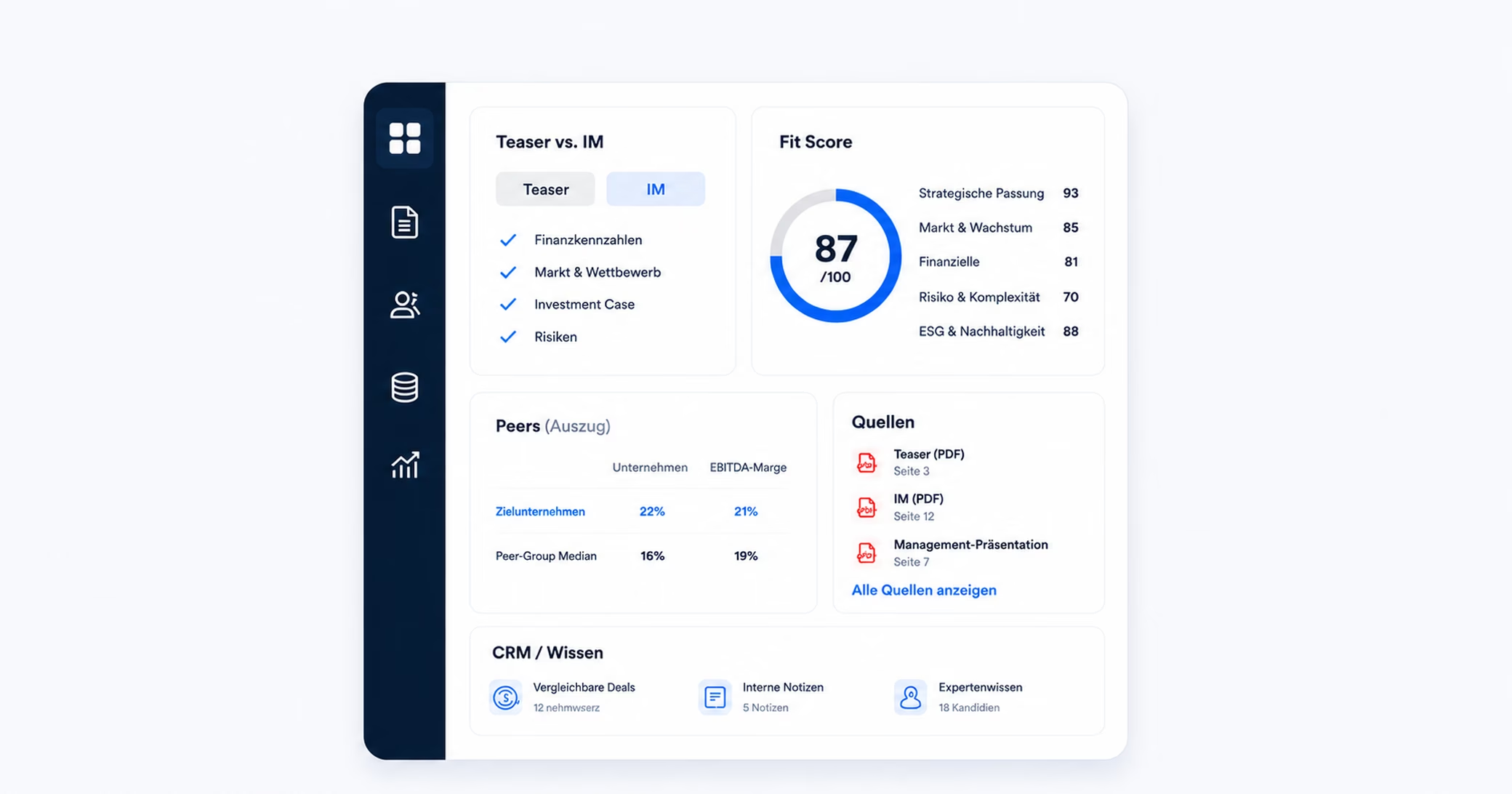
A platform should identify which document it has before choosing how to process it. Otherwise a teaser can invite unsupported inferences, while an IM can lose important details.
Compare companies in the right niche
Broad industry averages can be misleading for companies with €5 million to €50 million in revenue in Germany, Austria or Switzerland. Relevant peers usually come from the same market niche.
Start with the exact niche, then widen to the sub-sector and broader sector as needed. The firm's approved historical deals, CRM profiles and documents can provide more relevant context than public sector averages.
A score you can explain to the investment committee
A prose summary can help a reader get oriented. Initial screening also needs a consistent assessment that two analysts can reproduce against the same investment criteria.
A structured fit score checks each target against the same dimensions, including industry, business model, size and profitability. It produces an explained GO / REVIEW / NO-GO classification based on the firm's criteria. The team uses it to review the opportunity and retains responsibility for the decision.
Trace every finding to a source
An unsupported number can carry consequences. A screening platform should make every material finding traceable to the supporting document and flag missing evidence.
Use a protected project environment with access for authorised users. Keep documents, deals and analysis workflows appropriately separated. Traceable findings and access controls belong in the architecture from the start.
Make past deals useful for the next one
Years of deal data can remain hard to use when records are spread across files, incomplete or difficult to search.
Check CRM records for missing fields, inconsistent financial information and duplicates. Add reviewed data to a central repository with controlled access. Over time, a better-curated deal history can improve peer comparisons.
What to look for in a screening tool
Evaluate how the system distinguishes document types, applies the firm's investment criteria, retrieves relevant internal evidence and handles confidential material.
A platform can standardise the first review, make historical deal experience available to authorised colleagues and prepare a structured investment profile with peer comparisons and reasons for the assessment. The partners keep responsibility for qualitative evaluation, management conversations and investment decisions.
See how the platform works in our Silver Investment Partners case study. If you want to compare where AI could help in your own processes, start with the AI Opportunity Assessment.